
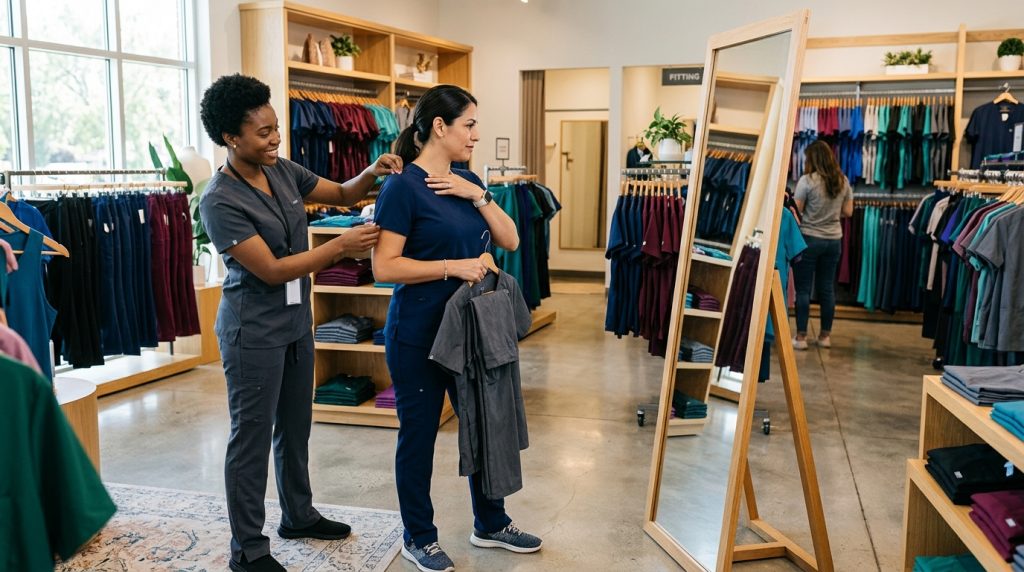

A professional medical scrub store should offer more than shelves of uniforms. It should help healthcare professionals identify the correct fit, fabric, size, inseam, pocket configuration, and workplace-approved style. A dependable store should also provide clear product information, practical return policies, knowledgeable assistance, and enough selection to accommodate different professions and body proportions.
The best place to buy scrubs is therefore not always the nearest store or the website with the largest inventory. It is the retailer that makes it easier to choose workwear that performs properly throughout the shift.
Quick answer
When choosing a medical scrub store, look for:
- Knowledgeable fitting assistance
- Multiple scrub brands and collections
- Women’s, men’s, maternity, petite, short, regular, tall, and extended sizing
- Clear fabric and stretch information
- Scrub tops, pants, jackets, lab coats, and accessories
- Useful filters for size, length, style, color, and profession
- Transparent return and exchange policies
- Support for workplace dress codes
- Group ordering and embroidery options when needed
- A physical location or reliable contact method
- Recent customer feedback about service and fit help
A store should help shoppers solve a workwear problem, not simply complete a transaction.
Why does choosing the right scrub store matter?
Medical scrubs are worn in jobs that may involve walking, bending, stretching, sitting, lifting, and repeated movement. The U.S. Bureau of Labor Statistics notes that registered nurses may spend substantial time walking, bending, stretching, and standing, while medical assistants may alternate between patient care and computer-based administrative work. These differences make fit and function important when selecting uniforms.
A scrub set that looks appropriate while standing can become uncomfortable when the wearer:
- Reaches forward
- Sits for documentation
- Bends repeatedly
- Walks quickly
- Carries items in the pockets
- Adds a jacket or lab coat
- Works in changing temperatures
An experienced scrub retailer should understand these practical concerns and help shoppers evaluate the full uniform rather than choosing based only on color or appearance.
Should medical scrubs be purchased locally or online?
Both options can work well.
The right choice depends on whether the shopper already knows the preferred size and collection, needs hands-on fitting assistance, or wants to compare several fabrics and cuts.
Benefits of visiting a physical scrub store
In-person shopping allows the customer to:
- Feel fabric weight and texture
- Compare stretch and structure
- Test several sizes
- Check neckline coverage
- Compare waistband designs
- Measure pant length with work shoes
- Load pockets with lightweight items
- Try jackets over scrub tops
- Receive immediate fit guidance
Someone searching for a medical scrubs store near me should therefore assess the quality of the fitting experience, not just the distance from home or work.
A nearby store is most valuable when the staff can explain why one garment fits differently from another and help the customer compare realistic options.
Benefits of buying scrubs online
Online shopping can provide:
- Convenient access outside store hours
- Easier browsing by category or brand
- Broader color availability
- Product details and size charts
- Access to specialty lengths
- Faster reordering of known styles
- Delivery for professionals with limited shopping time
The main disadvantage is that fabric feel and movement cannot be evaluated before the order arrives.
A strong online retailer should compensate by providing detailed product information, accurate filters, clear size guidance, and a reasonable exchange process.
The strongest option is often a hybrid retailer
A retailer with both a local store and an ecommerce catalog may offer the advantages of each model.
A shopper can:
- Receive an in-person fitting.
- Identify a reliable top, pant, size, and inseam.
- Record the product details.
- Reorder online when replacement sets are needed.
This approach is especially useful when the healthcare professional must wear a consistent color or uniform collection.
What product selection should a professional scrub store offer?
A store does not need to carry every scrub manufactured. It should, however, provide enough variety to address meaningful differences in body proportions, work environments, dress codes, and budgets.
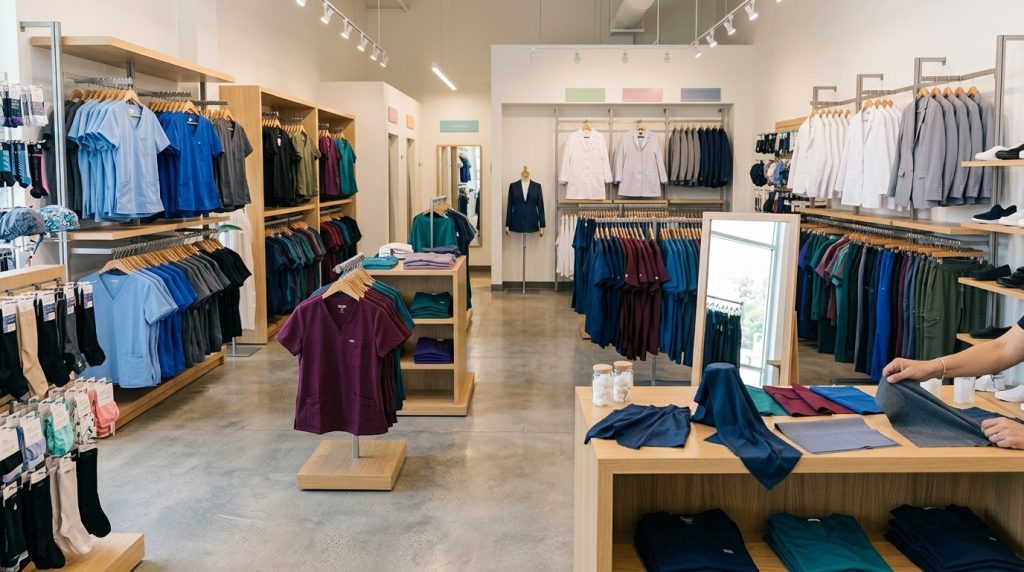
An established medical uniform shop should make it easy to find the relevant category without requiring the shopper to search through unrelated products.
Core product categories
A well-organized scrub retailer should normally offer access to:
- Women’s scrubs
- Men’s scrubs
- Scrub tops
- Scrub pants
- Scrub jackets
- Lab coats
- Maternity scrubs
- Print tops
- Underscrubs
- Medical accessories
- Work bags or clinical backpacks
- Gift options
Not every healthcare professional needs every category, but the selection should support complete workwear planning.
Multiple pant lengths
Pant length is one of the most common fit challenges.
Useful options may include:
- Petite
- Short
- Regular
- Tall
These terms are not always interchangeable.
A petite pant may adjust the rise, knee placement, and overall proportion, while a short-length pant may primarily shorten the inseam. The exact differences depend on the manufacturer and collection.
A professional store should help customers understand those distinctions rather than treating every shorter pant as the same product.
More than one scrub fit
Useful scrub-top fits may include:
- Relaxed
- Classic
- Contemporary
- Tailored
- Tuckable
- Unisex
Pant options may include:
- Straight leg
- Tapered
- Jogger
- Cargo
- Flare
- Bootcut
- Wide leg
A strong product range recognizes that healthcare professionals do not all have the same proportions or style preferences.
Why is brand and collection selection important?
Different brands may use different measurements, fabric blends, pocket systems, and fit terminology.
Even collections produced by the same manufacturer can differ in:
- Fabric weight
- Stretch
- Waistband design
- Rise
- Inseam
- Shoulder width
- Top length
- Pocket placement
- Price
- Care requirements
A professional store should not suggest that every medium, petite, or tall garment fits identically.
Collections create more consistent reordering
Once a healthcare professional finds a collection that fits properly, buying additional pieces from the same line may provide more consistent:
- Fabric
- Color
- Stretch
- Sizing
- Pocket design
- Overall appearance
This can simplify future uniform purchases.
However, the size chart should still be checked when changing from one garment style to another.
What fitting help should a scrub store provide?
Fitting assistance should be practical and specific.
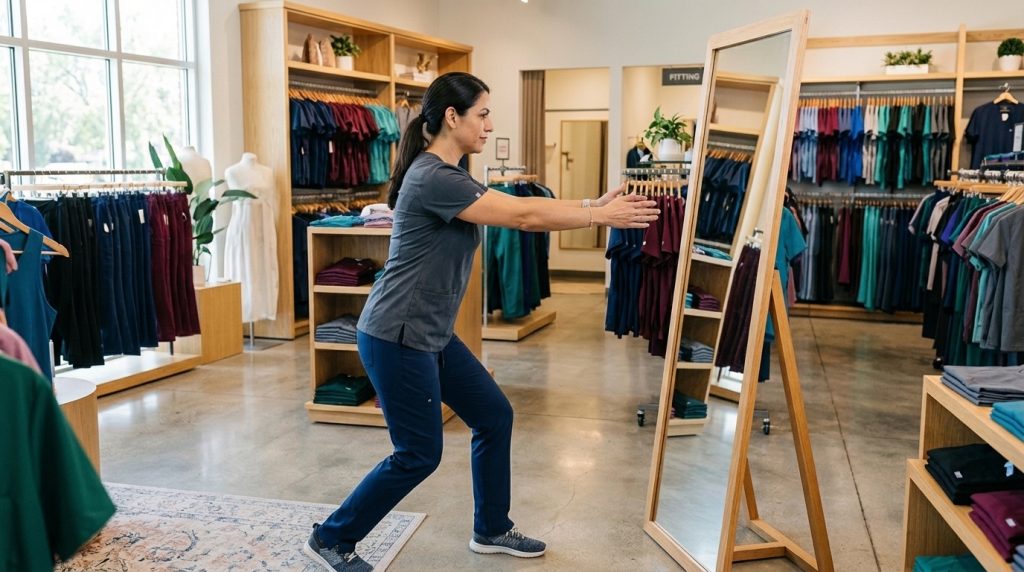
A knowledgeable employee should be able to help the shopper evaluate:
- Shoulder mobility
- Chest and torso room
- Neckline coverage
- Top length
- Hip and thigh fit
- Pant rise
- Waistband security
- Inseam
- Leg opening
- Jacket layering
- Pocket access
The purpose is not to decide what looks fashionable. It is to determine whether the garment supports the wearer’s body and work routine.
How should scrub tops be tested in a store?
A scrub top should be tested through movement.
The shopper should:
- Reach both arms forward.
- Raise both arms overhead.
- Rotate the upper body.
- Sit in a chair.
- Lean forward.
- Reach toward the floor carefully.
- Add a jacket when one is normally worn.
Signs that a scrub top may be too small
- Pulling across the upper back
- Tightness under the arms
- Tension across the chest
- The neckline lifting during movement
- The hem rising excessively
- Restricted shoulder rotation
Signs that a scrub top may be too large
- Shoulder seams falling too far down the arms
- Excess fabric under the arms
- The neckline shifting while bending
- Pockets hanging below a comfortable position
- The top bunching under a jacket
The correct fit should provide movement without unnecessary loose fabric.
How should scrub pants be tested?
Scrub pants should be evaluated while standing, sitting, walking, and bending.
Check the waistband
The waistband should remain secure without:
- Rolling
- Slipping
- Digging into the waist
- Creating pressure while sitting
- Requiring constant tightening
Available waistband types may include:
- Full elastic
- Drawstring
- Elastic with drawstring
- Yoga-style knit
- Flat-front hybrid designs
No single waistband works for every body type.
Check the rise
The rise affects how the pants fit between the waistband and crotch.
A rise that is too short may pull during sitting or bending. A rise that is too long may create bunching and excess fabric.
Check the hips and thighs
The pants should allow:
- Sitting
- Walking
- Knee bending
- Normal stride length
- Comfortable pocket use
Horizontal pulling lines may indicate insufficient room.
Check the inseam with work shoes
The customer should ideally try the pants with footwear similar to what will be worn at work.
The hem should not:
- Drag beneath the shoe
- Collect heavily around the ankle
- Rise excessively when sitting
- Position the shaped knee incorrectly
Should a scrub store carry different fabric options?
Yes. Fabric preference is highly individual.
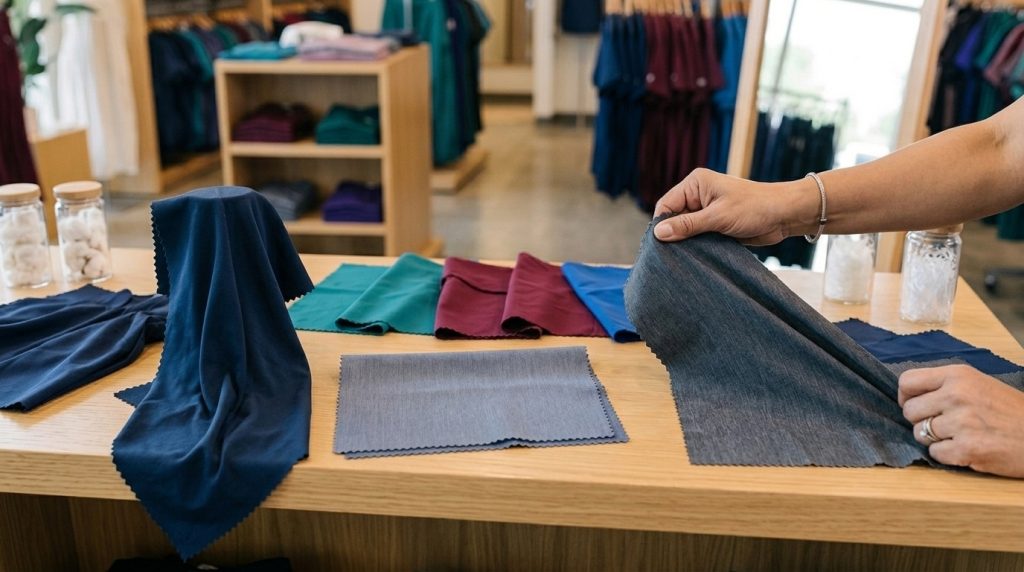
A professional retailer should offer enough variety for shoppers who prioritize:
- Lightweight construction
- Soft texture
- Cotton-like feel
- Stretch
- Wrinkle resistance
- Fluid drape
- Structured appearance
- Quick drying
- Easy care
The Federal Trade Commission explains that most textile products must include labels identifying fiber content, country of origin, and the manufacturer or another responsible business. Reviewing these labels helps shoppers understand what a garment contains rather than relying only on broad terms such as “performance fabric” or “premium stretch.”
Fiber content does not explain everything
Two garments with similar fiber percentages can feel different because of:
- Fabric weight
- Weave or knit
- Finishing
- Surface texture
- Garment cut
- Stretch recovery
A useful retailer should allow shoppers to compare the actual garments rather than suggesting that every polyester, cotton, or rayon blend performs identically.
Stretch recovery matters
Stretch is the ability of fabric to extend. Recovery is the ability to return to its original shape.
A fabric with poor recovery may become loose around:
- Knees
- Elbows
- Seat
- Waistband
- Pockets
Shoppers should gently test the material or review repeated online feedback about sagging, bagging, or shape retention.
How much information should an online scrub store provide?
A reliable product page should give shoppers enough information to make an informed decision.
Useful details include:
- Fabric composition
- Stretch description
- Fit type
- Neckline
- Top length
- Side vents
- Waistband construction
- Pant rise
- Leg shape
- Inseam options
- Pocket count
- Pocket placement
- Care instructions
- Available sizes
- Color options
- Return eligibility
Size charts should be product specific
A generic chart may not provide enough information when different collections use different proportions.
The product page should make it clear whether the chart refers to:
- Body measurements
- Finished garment measurements
- General brand sizing
- The exact style being viewed
Product photographs should show more than the front
Useful imagery may include:
- Front view
- Side view
- Back view
- Close-up of pockets
- Waistband detail
- Fabric texture
- Ankle opening
- Jacket closure
- Garment shown in motion
A store should not force shoppers to guess how the back, side, or waistband is constructed.
What return and exchange policies should be checked?
Scrub fit can vary between brands, styles, and collections, so the return policy is an important part of the purchase.
The Federal Trade Commission recommends checking whether returns are allowed, how long the return period lasts, who pays return shipping, and whether restocking fees apply. Sale and clearance products may also follow different rules.
Before purchasing, confirm:
- The return deadline
- Required condition of the garment
- Whether tags must remain attached
- Whether worn or washed items are excluded
- Whether clearance items are final sale
- Whether embroidery makes the item nonreturnable
- Who pays return shipping
- Whether exchanges are available
- Whether original shipping charges are refundable
Do not alter scrubs before approving the fit
A shopper should normally avoid:
- Washing
- Wearing the garment to work
- Removing tags
- Hemming
- Embroidering
- Heat pressing
- Writing a name inside
until the size and fit have been confirmed.
Should a scrub store offer role-based guidance?
Yes, but recommendations should remain practical rather than overly promotional.
Retailers offering scrubs for healthcare professionals should understand that different roles can have different needs.
Nurses and nursing assistants
Possible priorities include:
- Mobility
- Secure pockets
- Comfortable waistbands
- Easy layering
- Practical pant lengths
- Repeated-wash durability
Doctors and physician assistants
Possible priorities include:
- Professional appearance
- Layering under lab coats
- Tuckable tops
- Moderate storage
- Comfortable seated fit
- Coordinated colors
Dental professionals
Possible priorities include:
- Secure neckline coverage
- Shoulder flexibility
- Comfortable seated fit
- Lightweight fabric
- Pockets that do not interfere with leaning
Veterinary professionals
Possible priorities include:
- Flexible knees and hips
- Secure storage
- Durable fabric
- Easy care
- Minimal loose material
Medical and nursing students
Students may need help with:
- School-approved colors
- Required embroidery
- Program-specific styles
- Affordable uniform planning
- Correct sizing before clinical placements
The store should ask about the workplace or program before recommending a uniform.
What group and customization services may be useful?
Individual shoppers may only need one or two scrub sets. Healthcare employers, clinics, and schools often have additional requirements.
A professional uniform provider may offer:
- Bulk ordering
- Staff fittings
- Group pricing
- Custom ordering portals
- Department color programs
- Embroidery
- Logo placement
- Name personalization
- Employee allowances
- Payroll deduction
- Delivery coordination
- Replacement ordering
Embroidery should be delayed until the fit is confirmed
Personalized garments may no longer qualify for returns.
Before embroidery:
- Confirm the garment size.
- Approve the color.
- Verify spelling.
- Confirm logo placement.
- Check the employer’s uniform policy.
- Approve a sample when available.
Group orders should also account for different body proportions rather than placing every employee into one unisex style.
How can local reputation be evaluated?
A store’s local reputation can provide useful information about the shopping experience.
Review patterns rather than relying on one unusually positive or negative comment.
Look for repeated feedback about:
- Staff knowledge
- Fit assistance
- Size availability
- Exchanges
- Product quality
- Group orders
- Embroidery accuracy
- Communication
- Order readiness
- In-store experience
Healthcare professionals in Nebraska can also review the details and customer feedback for a local medical scrub store in Lincoln before planning an in-person visit.
Reviews should not replace direct verification
Business hours, return policies, inventory, services, and availability may change.
Before traveling, confirm:
- Current hours
- Whether appointments are needed
- Whether the desired size is available
- Whether fittings are offered
- Whether group services require advance notice
- Whether embroidery is completed onsite or sent elsewhere
What customer service questions should be asked?
A professional store should be able to answer specific questions.
Useful questions include:
- Does this style run fitted or relaxed?
- Is the size chart based on body measurements?
- What is the actual inseam?
- How does petite differ from short?
- Does this fabric stretch in two directions or four?
- Does the waistband have an internal drawstring?
- Can this jacket fit over the selected scrub top?
- Are the colors consistent across the collection?
- Can unworn items be exchanged?
- Does embroidery affect returns?
- Can replacement pieces be reordered later?
Vague answers do not necessarily mean the store is unreliable, but clear product knowledge makes the buying process safer and easier.
What are the warning signs of a poor scrub retailer?
Limited or unclear size information
A retailer should not expect shoppers to rely only on small, medium, or large labels.
No return policy
The terms should be available before payment.
Product descriptions with little useful detail
Descriptions should explain fit, fabric, pockets, length, and care.
Overstated medical claims
Scrubs are ordinary work clothing unless a specific garment is designed and classified for a protective purpose. CDC guidance states that general work clothes, including uniforms and scrubs, are not considered personal protective equipment.
A retailer should not imply that standard scrubs replace required gowns, gloves, masks, or other protective equipment.
Pressure to personalize before fitting
Embroidery or alteration should not occur until sizing has been approved.
One style presented as suitable for everyone
Body proportions and work requirements differ.
No reliable contact method
The shopper should be able to reach the business about sizing, delivery, returns, or damaged items.
Repeated complaints about unresolved orders
Individual problems can occur, but consistent patterns involving communication, missing orders, or refused legitimate returns deserve attention.
How should medical scrubs be inspected before purchase?
Inspect the seams
Check:
- Side seams
- Pocket corners
- Crotch seams
- Waistband attachment
- Jacket cuffs
- Zippers
- Drawstring openings
The stitching should appear secure and consistent.
Inspect the fabric
Look for:
- Thin areas
- Uneven color
- Pulls
- Loose threads
- Visible damage
- Excessive transparency under normal movement
Test the pockets
Place normal lightweight items in the pockets.
Confirm that:
- The neckline does not pull
- The waistband remains secure
- The pocket opening does not sag
- Objects do not fall out while sitting
- Items remain accessible
Check color consistency
When coordinating tops and pants, confirm that the shades match under normal lighting.
Two garments described with similar color names may not be identical if they come from different collections.
How should scrub care affect store selection?
A retailer should provide access to care instructions before or at the time of purchase.
The FTC’s Care Labeling Rule requires covered apparel to include regular care instructions, such as an appropriate washing or dry-cleaning method.
Consider:
- Wash temperature
- Dryer settings
- Bleach restrictions
- Ironing instructions
- Shrinkage concerns
- Whether the fabric requires special handling
The CDC notes that healthcare laundry can include uniforms and scrub suits and that healthcare facilities may have specific procedures for handling textiles. Personal garment care should therefore remain consistent with workplace requirements.
A professional store should not advise customers to ignore an employer’s laundering or infection-control policy.
A practical checklist for choosing a scrub store
Before buying, evaluate the retailer in five areas.
Product selection
- Does it carry the required uniform categories?
- Are appropriate sizes and lengths available?
- Are multiple fits offered?
- Can matching pieces be reordered?
Product information
- Is fiber content disclosed?
- Are size charts available?
- Are inseams listed?
- Are pocket and waistband details explained?
- Are care instructions accessible?
Service
- Can staff provide fit guidance?
- Is the business easy to contact?
- Are group or embroidery services available if needed?
- Can the shopper compare several options?
Policies
- Is the return policy clear?
- Are sale-item rules explained?
- Are personalization restrictions disclosed?
- Are delivery terms available?
Reputation
- Do reviews mention knowledgeable assistance?
- Are problems addressed professionally?
- Is business information current?
- Does the store appear established and accessible?
Final thoughts
The right medical scrub store should reduce uncertainty.
It should help healthcare professionals understand:
- Which size fits
- Which inseam is correct
- Which fabric suits the work environment
- Which pockets are genuinely useful
- Which color complies with the dress code
- Which return rules apply
- Whether customization is appropriate
- How replacement garments can be reordered
A nearby location is useful, but expertise, product organization, sizing support, and transparent policies are more important than proximity alone.
The best scrub retailer is the one that makes it easier to choose professional workwear correctly the first time and provides a dependable path for future replacements.
Frequently asked questions
Where is the best place to buy medical scrubs?
The best place is a specialist retailer that provides clear size information, multiple fits and lengths, practical fabric details, knowledgeable assistance, and transparent return policies. A physical store is useful for first-time fitting, while an online shop can simplify future reordering.
Is it better to buy medical scrubs in person?
In-person shopping is particularly helpful when trying a new brand, determining pant length, comparing fabrics, or choosing between fitted and relaxed styles. Online buying may be more convenient once the shopper already knows the correct collection, size, and inseam.
What should be worn when trying on scrubs?
Wear the underlayers and footwear normally used at work when possible. Test the scrubs while sitting, reaching, bending, walking, and wearing any usual jacket or lab coat. This provides a more realistic understanding of fit.
How can shoppers tell whether a scrub store is reliable?
Check the store’s contact information, product descriptions, size charts, return policy, customer feedback, and ability to answer detailed fit questions. Reliable retailers should make important terms available before the customer completes the purchase.
Should a scrub store offer petite and tall sizes?
A professional store should carry or provide access to multiple length options when possible. Petite, short, regular, and tall pants address different inseams and, in some cases, different rises and garment proportions.
Can embroidered scrubs normally be returned?
Personalized items are often restricted from return or exchange, but policies vary. The fit, color, spelling, and logo placement should be confirmed before embroidery or other permanent customization is completed.
Are scrubs considered protective equipment?
Ordinary scrubs and uniforms are generally work clothing, not personal protective equipment. Required gowns, gloves, masks, eye protection, and other protective garments should be selected and used according to workplace protocols.